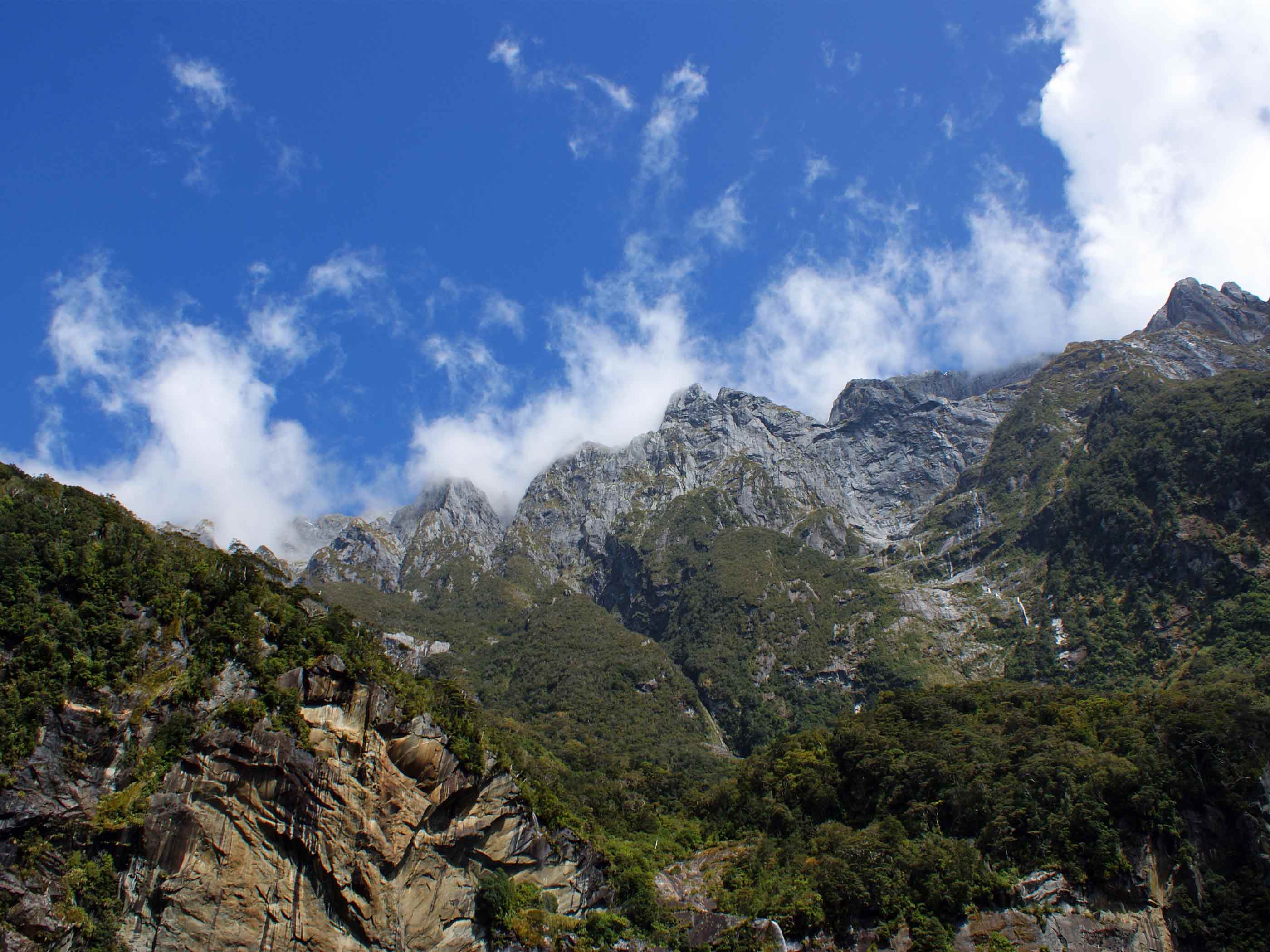


Landscape
New Zealand has a variety of landscapes and wildlife that differ between the two Islands.
The North Island has (some very large) green hills and reminds me of the UK countryside. As you move away from the cities the hills become bigger and it gives you a little taste of what awaits on the South Island.
You really get an idea of how fertile the land is on the North Island.
The environment seems so alive.
The North Island is home to New Zealand's largest tree, the Kauri tree. Logging by European settlers decimated the Kauri population and now only 4% still exist. The most famous Kauri trees are in the Waipoua Forest and are called Tane Mahuta and Te Matua Ngahere. Both are estimated to be over 2000 years old! Tane Mahuta is believed by the Maori to be the embodiment of the forest god. Tane Mahuta means 'Lord of the Forest'. It is believed that Tane Mahuta separates earth mother and sky father.
We took part in a tour of the Waipoua Forest called 'Footprints' with our Maori guide Tawhiri (pronounced 'Taffety'). He explained some of the Maori beliefs and sung a Maori prayer into the forest. We highly recommend this tour for any travellers wanting to get closer to the wildlife and culture of New Zealand.
When it comes to landscape, the South Island has it all from mountains, glaciers, mirror lakes, National Parks and fjords. Whereas the North Island seems alive, large parts of the South Island seem completely barren. The cooler climates and harsher land definitely make it harder for life to survive here.
The skyline is dominated by the Southern Alps and Mount Cook, the highest mountain in New Zealand, reaching a height of 3,754 metres (12,316 ft). The Southern Alps run down most of the South Island and so can be seen from almost anywhere.
There are two popular glaciers on the South Island, Franz Josef Glacier and Fox Glacier. These are two of the most accessible glaciers in the world, being 2 of 3 glaciers in the world whose terminal face is below 300 metres and so close to the coastline. Because the glacier is so close to sea level, the terminal face is actually surrounded by lush forest/shrub land.
We hiked up Franz Josef and it was such a great experience. Very tiring but the photos we took were some of the best of the trip and it was also one of the most rewarding activities we did. During the hike you can hear what sounds like thunder but it is the glacier advancing or retreating (it really wasn’t thunder because it was a clear sunny day). We were told that the glacier is retreating about a metre a day at the bottom and advancing 5 metres a day at the top.
New Zealand has numerous National Parks, some of the more popular ones being Abel Tazman National Park, Tongariro National Park and Fiordland National Park.
Abel Tazman National Park is New Zealand's smallest National Park (at 225km2 it's still pretty large) It has both forests and sandy beaches and is very popular for trekking and camping. Sea Kayaking is also popular here.
Tongariro National Park is situated on the North Island and is New Zealand's oldest National Park. Its biggest attractions are the three active volcanoes Mount Ruapehu, Mount Ngauruhoe, and Mount Tongariro. Mount Ngauruhoe appeared in the Lord of the Rings Trilogy as Mount Doom. The surrounding area was also used for filming. Climbing, hiking and skiing are popular activities in the National park.
Fiordland National Park is the largest in New Zealand and one of the largest in the world. It attracts trekkers and tourists keen to see its most popular fiord, Milford Sound. Boat tours allow you to sail through the Fiord and get up close to some of the waterfalls and wildlife, as well as Mitre Peak, a famous mountain in this region.
We spent a day at Abel Tazman National Park and enjoyed it very much. We took lots of pictures of the coast line and waterfalls. We walked from Torrent Bay to Marahau, a 4 hour walk. A word of advice, however many hours the walk is supposed to take, add 1-2 hours, the walk took us 6 1/2 hours. We almost missed the last coach back to the hostel (we were 7 minutes late, thankfully the coach was 10 minutes late!) and this was after jogging the last hour and cutting across a beach thanks to low tide! If you don’t like long treks then shorter walking tracks are also available.
We also visited Milford Sound and some mirror lakes en route. We spent about an hour on the boat which sailed out to where the fjord reaches the sea. We sailed past a colony of seals on a rock and past lots of waterfalls. The weather was very changeable while we were on the boat, it kept changing between sunny blue skies to grey cloudy rain. It was a really good experience and a little mystical.
Our only complaint is that I would have liked more time sailing on the fjord. The majority of the day was spent travelling to and from Milford Sound (from Queenstown).
Wildlife
Before settlement, New Zealand’s only mammals were three species of bat. New Zealand had a high population of birds and with no land mammals to prey on them, many lost the ability to fly such as the Kiwi and the now extinct Moa.
The Kiwi is New Zealand’s national symbol. They are an endangered species and can be found in areas throughout New Zealand. Kiwis can be difficult to find due to their rarity and because they are nocturnal.
We didn’t see or hear any wild Kiwis during our journey.
The Moa was a large flightless bird that resembled an ostrich and reached 3.7m (12 ft) in height. Early Maori settlers are thought to have hunted the birds to extinction.
Another interesting extinct bird is the Haast’s Eagle which was largest eagle known to have existed weighing between 10-15 kg with a wingspan of about 3 metres (10 ft) at most.
Famous New Zealand birds include the Kea, Tui (also the name of a New Zealand beer), Bellbird and the Silvereye.
New Zealand has no venomous animals that can harm humans except for three types of spiders. Don't let this worry you, we didn’t see any venomous spiders during our month long trip. Just be aware that they exist.
We found a useful site which has a leaflet available for download which better describes these three spiders.
New Zealand also has one the largest insects in the world, the Weta. It has a body length of up to 10cm (4 inches) and can weigh as much as 70 grams. They live in trees, suburban areas and caves.